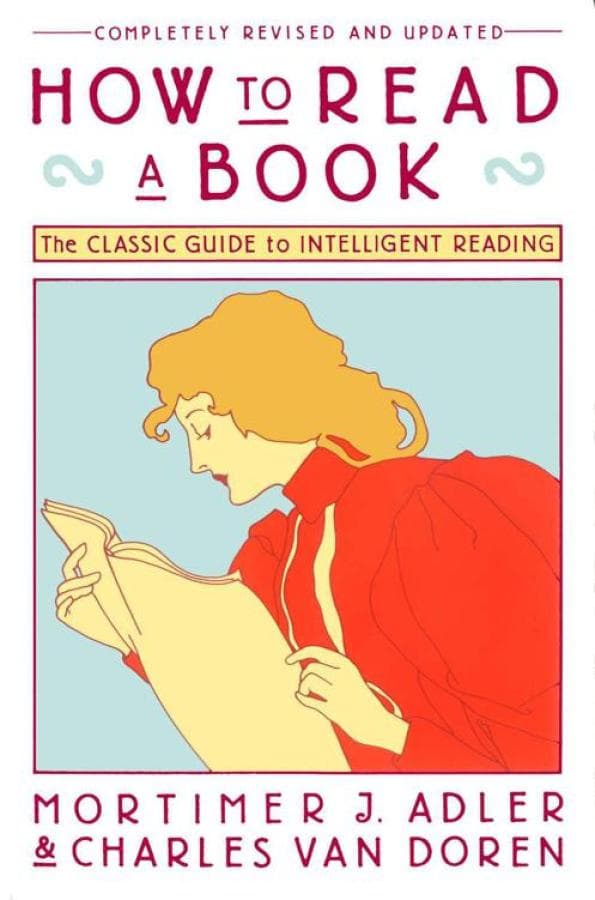
How to Read a Book was first published in the early months of 1940. To my surprise and, I confess, to my delight, it immediately became a best seller and remained at the top of the nationwide best-seller list for more than a year. Since 1940, it has continued to be widely circulated in numerous printings, both hardcover and paperback, and it has been translated into other languages—French, Swedish, German, Spanish, and Italian. Why, then, attempt to recast and rewrite the book for the present generation of readers?
The reasons for doing so lie in changes that have taken place both in our society in the last thirty years and in the subject itself. Today many more of the young men and women who complete high school enter and complete four years of college; a much larger proportion of the population has become literate in spite of or even because of the popularity of radio and television. There has been a shift of interest from the reading of fiction to the reading of nonfiction. The educators of the country have acknowledged that teaching the young to read, in the most elementary sense of that word, is our paramount educational problem. A recent Secretary of the Department of Health, Education, and Welfare, designating the seventies as the Decade of Reading, has dedicated federal funds in support of a wide variety of efforts to improve proficiency in this basic skill, and many of those efforts have scored some success at the level at which children are initiated into the art of reading. In addition, adults in large numbers have been captivated by the glittering promises made by speed-reading courses—promises to increase their comprehension of what they read as well as their speed in reading it.
However, certain things have not changed in the last thirty years. One constant is that, to achieve all the purposes of reading, the desideratum must be the ability to read different things at different—appropriate—speeds, not everything at the greatest possible speed. As Pascal observed three hundred years ago, “When we read too fast or too slowly, we understand nothing.” Since speed-reading has become a national fad, this new edition of How to Read a Book deals with the problem and proposes variable-speed-reading as the solution, the aim being to read better, always better, but sometimes slower, sometimes faster.
Another thing that has not changed, unfortunately, is the failure to carry instruction in reading beyond the elementary level. Most of our educational ingenuity, money, and effort is spent on reading instruction in the first six grades. Beyond that, little formal training is provided to carry students to higher and quite distinct levels of skill. That was true in 1939 when Professor James Mursell of Columbia University’s Teachers College wrote an article for the Atlantic Monthly entitled “The Failure of the Schools.” What he said then, in two paragraphs that I am now going to quote, is still true.
تجربهٔ کامل مطالعه با تمهای روشن/کاهی/شب، تنظیم قلم، هایلایت و مطالعهٔ برونخط.
گفتوگو دربارهٔ کتاب
نظرها پس از تأیید کتابدار نمایش داده میشوندبرای نوشتن دیدگاه و امتیاز، به صفحهٔ کتاب بروید.
هنوز دیدگاهی برای این کتاب ثبت نشده است.